High AI awareness. Low sustained adoption. The Caribbean’s AI gap is not a demand problem — it is a structured, multi-layer infrastructure failure. A systems analysis.
The Promise and the Reality Gap
Artificial intelligence is frequently described as a democratizing force. In theory, the world’s most capable AI tools are accessible to anyone with an internet connection. Platforms like ChatGPT, Claude, Gemini, Copilot, and dozens of specialized AI applications are deployed on global cloud infrastructure — architected, in principle, for borderless access.
In practice, access is deeply uneven. And in regions such as the Caribbean, this gap is neither incidental nor temporary. It is structural.
The popular narrative positions AI adoption as a question of awareness, education, or digital literacy. When adoption rates are low in a given region, the instinct is to diagnose a skills gap, a readiness gap, or a cultural resistance to technology. This instinct is wrong — or at least, it is wrong as a first-order explanation for the Caribbean.
“The issue is not whether AI exists. The issue is whether users can successfully reach and use it — and whether the infrastructure that governs that journey is aligned with Caribbean realities.”
This analysis examines the Caribbean’s AI access problem through a systems lens. It maps the specific infrastructure layers where access collapses, explains why those failures are misread as demand failures, and outlines what must change for equitable AI adoption to become possible in the region.
The Hidden System Behind Every AI Sign-Up
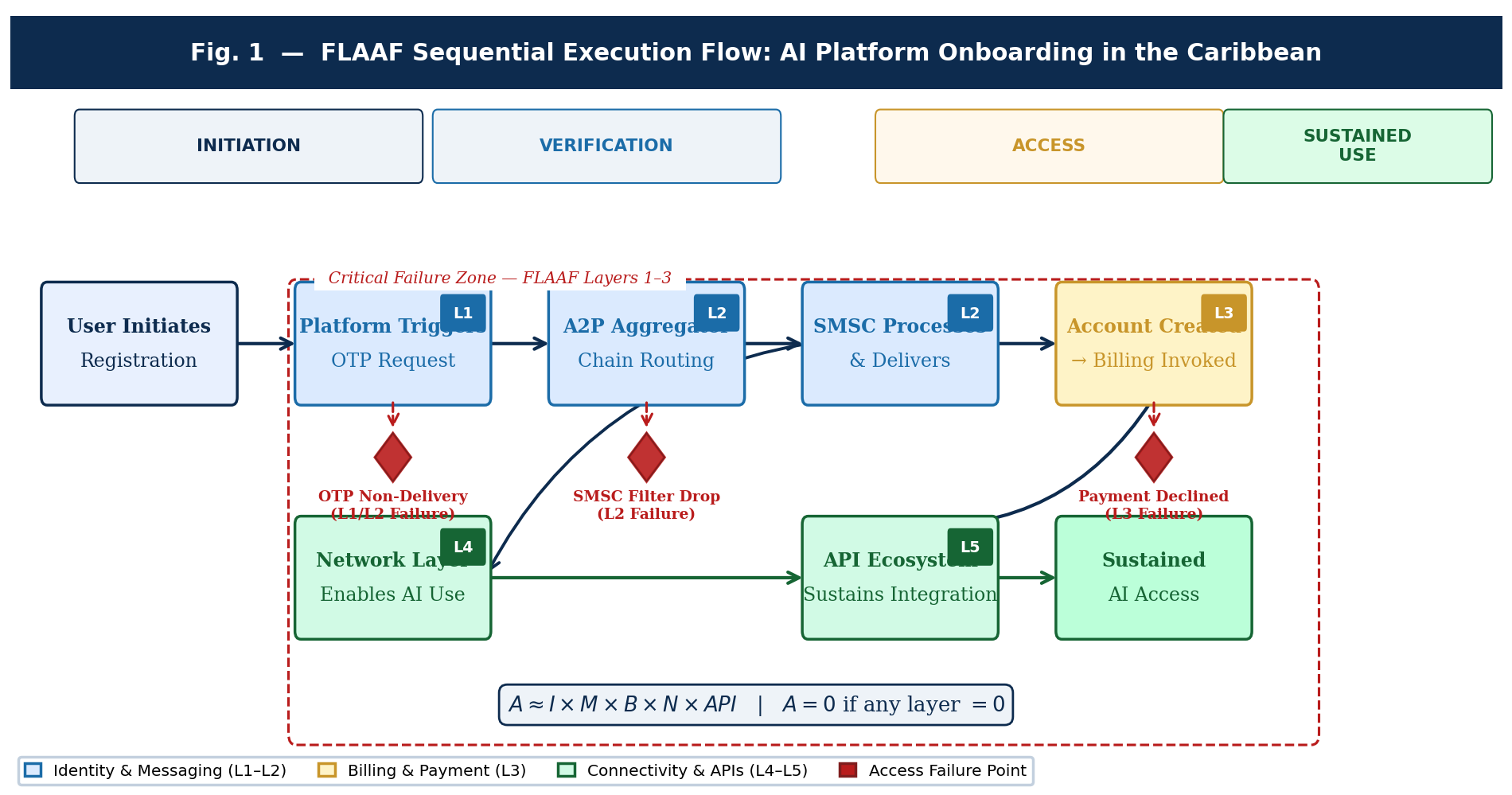
When a person in Kingston, Port of Spain, Bridgetown, or Nassau attempts to sign up for an AI platform, they initiate a process that is far more complex than it appears. From the user’s perspective, there is a screen, a form, and an expectation of access. Behind that screen is a sequence of infrastructure-dependent processes, each with its own failure modes.
Layer 1: Identity Verification
Most AI platforms require identity verification before granting access. The dominant mechanism is SMS-based one-time password (OTP) delivery — a system so normalized in high-income markets that its fragility in other contexts is rarely examined.
When a user submits their phone number to an AI platform, a message is generated and handed off to an Application-to-Person (A2P) messaging network. That message travels through a chain of intermediaries — aggregators, regional carriers, and local telecoms — before arriving at the user’s handset. Each handpoint in this chain introduces latency, filtering risk, and potential failure.
In Caribbean markets, this chain frequently breaks. Reasons include: lack of direct interconnection agreements between international A2P aggregators and regional carriers; automated spam filtering that flags international OTP traffic; routing inefficiencies that introduce delays long enough to expire the OTP before it arrives; and in some cases, deliberate filtering by carriers to manage network load or reduce grey-route traffic.
The user sees a simple failure: no code arrives. The platform may display a generic error or offer a resend option that also fails. The user concludes the platform is broken, or that they are somehow excluded. Neither conclusion is technically accurate, but both result in the same outcome: the user does not gain access.
This is not a Caribbean readiness problem. It is an A2P routing problem. OTP delivery failure is one of the most common and least visible barriers to AI platform access in the Caribbean. It does not appear in adoption metrics because users never get far enough to be counted as having attempted onboarding.
Layer 2: Payment Infrastructure
For users who successfully pass identity verification, the next barrier is payment. Most globally deployed AI platforms — including paid tiers of ChatGPT, Claude, Midjourney, GitHub Copilot, and others — require internationally supported credit cards or payment methods compatible with global billing infrastructure.
Caribbean financial systems are improving in terms of digital payment coverage, but significant gaps persist. Visa and Mastercard penetration varies substantially by country and income segment. Debit card international transaction enablement is inconsistent. Prepaid cards — the most accessible card type across many Caribbean markets — are frequently blocked by AI platforms due to fraud risk rules applied at a global level, without regional calibration.
Alternative payment mechanisms that have expanded AI access in other developing regions — carrier billing, mobile money, regional e-wallets — are largely absent from AI platform payment options in the Caribbean. The result is a population segment that has technically passed identity verification but cannot convert intent into subscription.
This is not a financial exclusion problem in the traditional sense. Many affected users are banked, employed, and capable of payment. The problem is interoperability: the payment methods they hold are not recognized by the systems AI platforms have configured for billing.
Layer 3: Data Affordability and Network Reliability
Even for users who clear the identity and payment barriers, sustained AI use depends on connectivity that is both reliable and affordable. This third layer is perhaps the most underappreciated, because it does not prevent initial access — it prevents meaningful adoption.
AI tools are inherently interactive. Large language model interfaces, image generation tools, and AI-assisted workflows require frequent API calls, real-time responses, and sustained sessions. These interaction patterns consume data in ways that are difficult to predict and expensive at Caribbean data pricing.
Network reliability adds a compounding factor. Intermittent connectivity — common in parts of the Caribbean — creates a degraded experience for AI tools that assume persistent session state. A dropped connection during an AI workflow can mean lost context, lost work, and lost confidence in the tool’s reliability.
Users in this position do not necessarily report inability to access AI. They report that AI tools are unreliable, too expensive to use regularly, or not worth the trouble. Their disengagement is captured as low adoption, not as a connectivity failure — obscuring the true structural cause.
A Systems Model of AI Accessibility
Understanding AI access in the Caribbean requires moving beyond individual barriers and toward a systems view. Each infrastructure layer does not simply make access harder — it acts as a gate. And because these gates operate in sequence, failure at any point collapses the entire access pathway.
AI accessibility can be modeled as a multiplicative function of five interdependent infrastructure layers:
A ≈ I × M × B × N × API
Where A = Overall Accessibility, I = Identity Verification, M = Messaging Delivery, B = Billing/Payment, N = Network Reliability, API = Platform API Access.
The multiplicative structure is the critical insight. In an additive model, weakness in one layer could be compensated by strength in another. In a multiplicative model, a value near zero in any single layer drives overall accessibility toward zero — regardless of how well the other layers perform.
A user in a Caribbean market with excellent mobile data, a supported credit card, and high AI awareness can still be blocked entirely if the A2P messaging layer fails to deliver their OTP. A user who successfully verifies their identity and has reliable connectivity cannot sustain use if their payment method is not recognized. The system as a whole is only as strong as its weakest layer.
This model explains a pattern that is increasingly visible across Caribbean markets: high awareness of AI tools, genuine interest in adoption, but low sustained use. The failure is not a demand failure. It is a structured drop-off across multiple infrastructure layers that compound to create near-total exclusion for a significant portion of the population.
Why Infrastructure Failure Gets Misread as Adoption Failure
One of the most consequential errors in AI inclusion discourse is the misattribution of infrastructure failure as demand failure. When regional adoption rates for AI tools are low, the default analytical framing tends toward questions of readiness, education, awareness, or cultural receptivity. These are not wrong questions — but they are the wrong first questions.
Infrastructure failure is largely invisible in the data. A user who cannot receive an OTP never appears in platform analytics as a failed user — they simply do not exist in the system. A user who abandons onboarding after a payment rejection may be coded as low intent. A user who tries an AI tool twice and finds it slow and expensive does not generate a support ticket — they simply disengage.
The result is a systematic undercounting of infrastructure-driven exclusion. Adoption metrics show low numbers. Analysts attribute those numbers to demand-side factors. Interventions focus on digital literacy campaigns, AI awareness programs, and training initiatives. The infrastructure layers remain unaddressed. The low adoption numbers persist.
“Access failure is often misinterpreted as lack of adoption or lack of readiness. In reality, it is a function of system misalignment — and that distinction matters enormously for how we design interventions.”
This misattribution has resource implications. Money spent on AI awareness campaigns does not address OTP routing failures. Training programs do not fix payment interoperability gaps. Infrastructure investment is the prerequisite — awareness and training are valuable, but secondary, interventions.
It also has narrative implications. When Caribbean populations are described as “not yet ready” for AI, the framing obscures agency and structural responsibility. Caribbean users are not waiting to be ready. They are being systematically excluded by infrastructure that was not designed with their context in mind.
The Telecom Imperative: Why Operators Are the Pivot Point
Telecommunications operators sit at the intersection of every infrastructure layer that governs AI access. Identity verification relies on telecom-managed messaging networks. Billing alternatives depend on telecom billing infrastructure. Connectivity is a telecom product. The API layer is partly governed by data policies and network prioritization decisions made by carriers.
In the Caribbean, the dominant operators — Digicel, Flow (operated by Liberty Latin America), and a range of smaller regional and national providers — control the primary access infrastructure for the majority of the region’s population. Their decisions about interconnection agreements, A2P routing, carrier billing, and API ecosystem development will, more than any other factor, determine the pace and equity of AI adoption in the region.
A2P Messaging Infrastructure: Direct interconnection agreements with international A2P messaging aggregators would substantially reduce OTP delivery failure rates. The business case is clear: improved delivery rates translate to higher platform adoption, higher data consumption, and new revenue streams from messaging volume.
Alternative Authentication Infrastructure: Moving beyond SMS-based OTP to support SIM-based authentication protocols — such as GSMA Mobile Connect — would reduce dependency on A2P routing and improve both reliability and security. This positions operators as identity infrastructure providers in the AI era.
Carrier Billing for AI Platforms: Carrier billing — allowing users to pay for digital subscriptions via their mobile account — is deployed in other developing regions with significant impact on digital service adoption. In markets where internationally supported credit cards are not universally accessible, carrier billing is not a workaround; it is the primary viable payment mechanism.
AI-Optimized Data Products: Data bundles designed specifically for AI tool use — lower latency routing, stable session management, usage-based pricing that accounts for AI interaction patterns — would reduce both the cost and reliability barriers to sustained use.
API Ecosystem Development: The more strategic opportunity is for Caribbean telecom operators to position themselves as the API layer for regional AI deployment — providing verified identity, billing, and connectivity services to AI platforms operating in the region. This transforms the operator from a passive infrastructure provider to an active participant in the AI value chain.
The Policy Dimension: AI Inclusion Requires Infrastructure Policy
Infrastructure alignment is necessary but not sufficient. The structural conditions that govern AI access in the Caribbean also require policy-level intervention — at national, regional, and international levels.
At the national level, AI inclusion policy must account for infrastructure constraints rather than simply mandating technology adoption. National digital economy strategies that include AI adoption targets without addressing the underlying infrastructure barriers are setting those targets up to fail.
At the regional level, CARICOM and related bodies have an opportunity to pursue harmonized approaches to digital payment interoperability, A2P messaging standards, and AI platform licensing. Regional coordination reduces the negotiating disadvantage that individual small-island states face when engaging with global AI platforms.
At the international level, the conversation about AI inclusion must shift from content and capabilities to infrastructure and systems. International development institutions with Caribbean mandates have a role in funding infrastructure alignment initiatives that fall below the commercial threshold for private investment.
AI inclusion is not about making tools available. It is about ensuring the systems required to access those tools are interoperable. Readiness frameworks that do not include infrastructure layer assessment will consistently misdiagnose the problem and misdirect the solution.
What Needs to Happen: A Prioritized Agenda
Immediate — Diagnose Before Prescribing
Regional AI stakeholders need granular, infrastructure-layer data on AI access failure rates in Caribbean markets. This means moving beyond broad adoption surveys to structured testing of OTP delivery rates, payment method compatibility, and connectivity performance across specific AI platforms in specific countries. You cannot fix what you have not measured.
Short-Term — Commercial Negotiations at the Infrastructure Layer
Telecom operators should initiate or accelerate commercial negotiations with major AI platform providers around three specific agreements: A2P direct interconnection to improve OTP delivery; carrier billing integration for AI subscriptions; and data product design tailored to AI use patterns. These are commercial deals, not policy reforms — they can move faster than regulation.
Medium-Term — Regional Payment Interoperability
CARICOM-level coordination on digital payment interoperability — enabling a common digital payment identity that AI platforms can recognize as a valid billing method — would remove one of the most persistent structural barriers to access. This requires both regulatory cooperation and commercial standardization.
Longer-Term — Caribbean-Centered AI Infrastructure Design
The most durable solution is for Caribbean institutions — governments, regulators, development banks, and universities — to participate in the design of AI infrastructure standards that account for infrastructure-constrained contexts from the outset. AI platforms designed to assume universal SMS delivery and global payment system coverage will continue to fail Caribbean users until the Caribbean is represented in the rooms where those design decisions are made.
Conclusion: Infrastructure Alignment Is the Work
Artificial intelligence has genuine and significant potential to transform access to knowledge, economic opportunity, and public services in the Caribbean. That potential is real. But it will not be realized by deploying more AI models or running more AI literacy campaigns in isolation.
The primary barrier to AI adoption in the Caribbean is not technological capability, and it is not demand. It is infrastructure interoperability — the gap between what global AI platforms assume about the systems their users sit within, and the actual architecture of digital access across Caribbean markets.
The systems that connect Caribbean users to AI platforms — identity, messaging, billing, connectivity, APIs — must be reliable, aligned, and locally accountable. Until they are, access will remain uneven. And the communities with the most to gain from AI-enabled knowledge and opportunity will continue to be the ones least able to reach it.
“The next phase of AI adoption in the Caribbean will not be defined by model capability. It will be defined by whether the infrastructure required to access those models has been aligned with Caribbean realities.”
About the Author
Kai Clarke is an AI Governance and Enablement Specialist based in Jamaica. She is Founder of Ethica AI Caribbean and Co-Lead of the Education and Research division at the Jamaica AI Association. Her work focuses on designing inclusive AI systems across infrastructure-constrained environments, with a primary focus on the Caribbean and Latin America.
This analysis forms part of ongoing research into inclusive AI systems design across infrastructure-constrained environments, with a focus on the Caribbean and Latin America.
If you are working on AI deployment, telecom infrastructure, or digital inclusion — or if this research is relevant to your work — I would welcome a conversation.
Areas of focus include AI Infrastructure Strategy, Telecom–AI Integration Advisory, and Inclusive AI Policy and Framework Design.
linkedin.com/in/kaimycahclarke